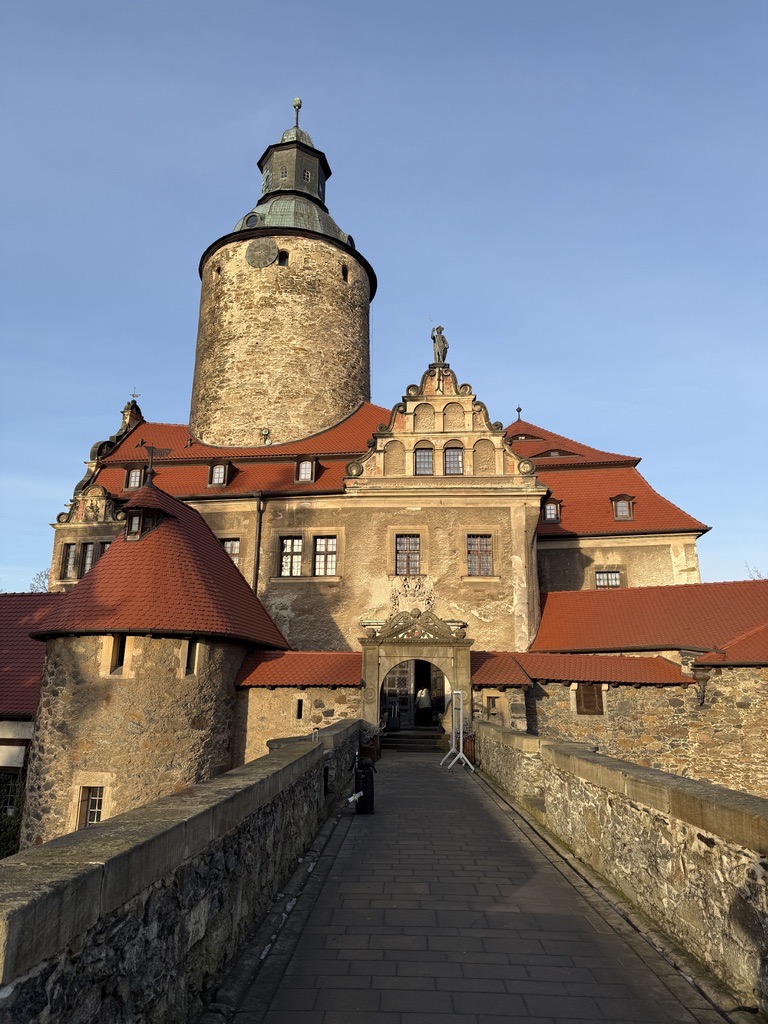
At the beginning of December I participated in a LARP called Heirs of the Dragon. This LARP, inspired by George R. R. Martin’s Song of Ice and Fire novels, was set at the Great Council of 101AC, 180 years before the events of the main book series and 30 years before the Dance of the Dragons. The LARP took place in its own timeline, such that the events of the LARP did not necessarily have to be consistent with those of any book or TV show set at a later time.
This was an “international blockbuster LARP,” meaning that it had a large cast (130 players), a highly detailed and immersive setting (the marvelous Czocha Castle in Poland, which dates to the 13th century and has hosted many a LARP), magnificent costumes (provided by the players), and prewritten characters. It’s one of the best LARPs I have played, although I did have a few issues, most of which I would ascribe to myself as a player.
This report will include SPOILERS for the game. Be warned!
The scenario of the game was this: it’s been a hundred years since Aegon Targaryen, “Aegon the Conqueror,” came out of Valyria with his two sister-wives and three dragons and conquered Westeros, becoming the first King of the Andals and the First Men. His grandson, Jaehaerys Targaryen, has ruled wisely for over 50 years and the Seven Kingdoms are generally peaceful and prosperous. But, unfortunately, his two sons Aemon and Baelon both predeceased him, leaving the succession in question, so he has called a Great Council of all the lords of the great houses of Westeros to decide who should succeed him. The game took place over three real-time days at the Great Council, with the final vote to determine the succession as the climax of the game. Although the Great Council in the books had over a thousand attendees, the LARP had only 130 and only 40 of those were Lords of their House and thus voting members of the Council. The remaining players and NPCs were relatives, vassals, servants, hangers-on, and foreign guests.
One of the major aspects of game play involved which of the Seven Kingdoms a character belonged to: the North (of whom the most prominent house was the Starks), the Iron Islands (Greyjoys), the Vale (Arryns), the Riverlands (Tullys), the Crownlands (Targaryens), the Westerlands (Lannisters), the Reach (Tyrells), the Stormlands (Baratheons), and Dorne (Martells). (But wait, I hear you cry, isn’t that nine? Well, the term “Seven Kingdoms” refers to the seven kingdoms conquered by Aegon; the Riverlands and Crownlands never had kings of their own.) Your character’s Kingdom determined your major allies and enemies, your family history, your style of clothing, and to a surprising extent your personality.
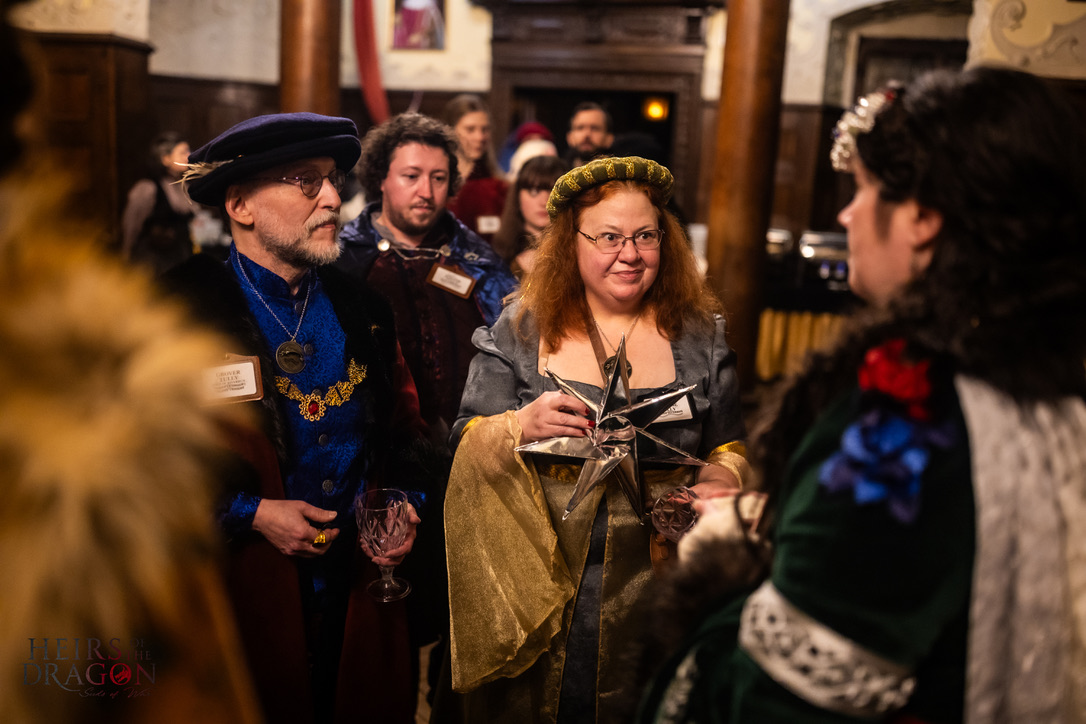
I played Grover Tully, Lord Paramount of the Riverlands, and my partner Alisa played my wife Celesse Tully. This was a position of considerable political power, roughly equivalent to the Governor of a US State, but ruling the Riverlands was like herding cats and many of my bannermen (vassals) were not the sort of people who could just be ordered around. The Strongs of Harrenhal had the largest castle in Westeros and ambition to match; the Freys of the Twins held the only crossing of the Trident River and guarded their toll monopoly jealously; the Mallisters of Seaguard were focused on the predations of the Black Star pirates at the expense of the needs of the inland Riverlands; and the Brackens and Blackwoods had been murdering each other for centuries. But as Alys Rivers said in House of the Dragon, “House Tully is not the largest house in the Riverlands, nor is it the richest, but it is the most stable. The Tullys’ wisdom has kept the river houses in line for centuries. They would kill each other to the last man if it were not for their liege lord.” So I elected to play the character as one who ruled through persuasion and negotiation rather than force. I will say that this strategy generally worked well, and I managed to get through the whole game without any violence between the Brackens and Blackwoods, so yay me.
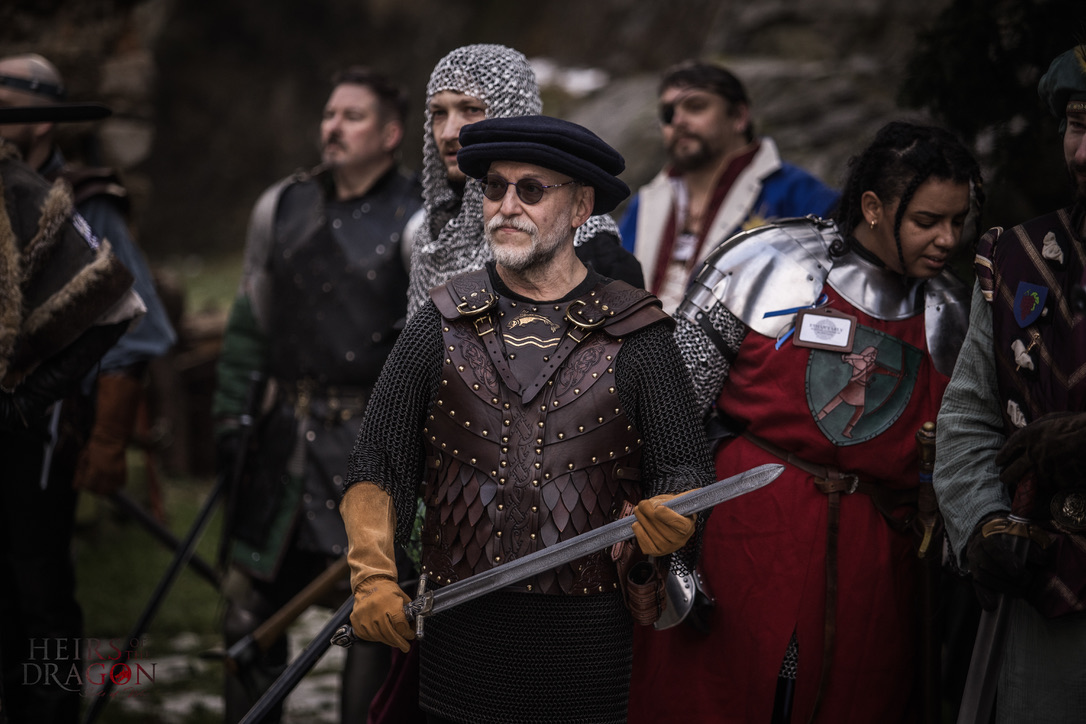
I really got into the whole Tully thing. The organizers of the LARP had recommended several costume makers, and I’d ordered top-of-the-line costumes for me and Alisa, in the house colors of red and blue with beautiful scale and fish details. I also went so far as to have custom leather-scale armor made with a Tully fish sigil on the breastplate. And, of course, there’s no point having armor unless you’re ready to fight, so I obtained a LARP sword (which barely fit diagonally in my largest suitcase) and took sword fighting lessons (at a lightsaber academy in the basement of the nearly-dead Lloyd Center mall, believe it or not). I never really got very good with the sword, honestly, and the one time I really used it was in the grand melee, where I got eliminated quite quickly, but I think I looked and felt better than I would have if I hadn’t taken those lessons.
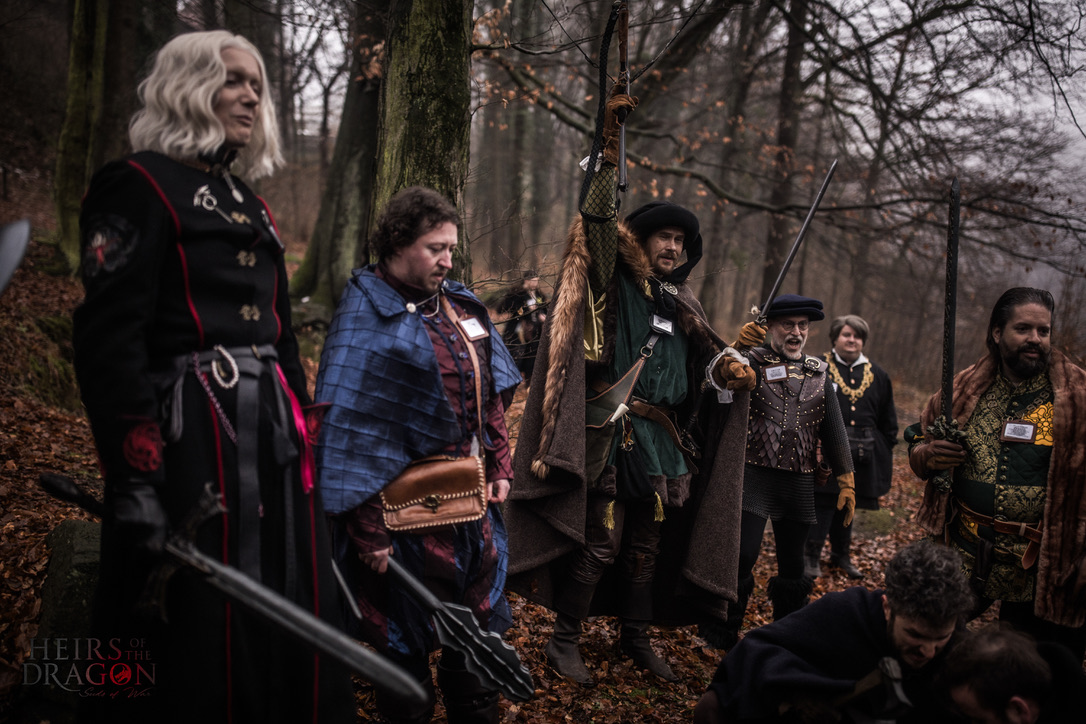
As you might expect if you’ve read the books or seen the TV shows, the LARP was absolutely packed with drama. There were so many different games being played at once: the national political game (who should succeed Jaehaerys); the national economic game (largely focused on two major projects seeking funding and resources); various regional and local political and economic games; games of romance, marriage, and fidelity; games of personal rivalry and jealousy; games of intrigue, espionage, and murder; games of mysticism and religion. Almost everyone was involved in at least two or three of these subplots at once.
As Lord Paramount of one of the Seven Kingdoms, the national political and economic games were naturally very important to me, especially the major question of succession which was the reason the Grand Council had been called in the first place. Although there were many claimants to the throne, most of them had extremely dubious claims and many people, including me, dismissed them out of hand. The two serious claimants were Princess Rhaenys Targaryen, the only child of Jaehaerys’s eldest son Aemon, and Prince Viserys Targaryen, the eldest son of Jaehaerys’s younger son Baelon. One of the big conflicts in my character sheet was that my character felt that Rhaenys had the stronger claim, but my wife Celesse — who had a vote of her own on the Council as the representative of her birth house Grafton — favored Viserys. Should I order her to vote my way? Also, given that the Grand Council was being held at Harrenhal, in the Riverlands, the Riverlanders were the largest single delegation and if they could all be persuaded to vote in the same way I could perhaps use this for leverage. (If. Ha ha.)
Although my character sheet told me I preferred Rhaenys, I felt that both claimants deserved a fair hearing and so I set out to meet both of them personally. However, although I did join in a bear hunt with Viserys (which was awesome) and had several personal meetings with him on questions regarding his potential rule, I never managed to have a meeting with Rhaenys. We were both so busy! The one time she managed to find me and say “hey, can we talk now?” I was busy trying to arrange a wedding and had to beg off. I found Viserys very personable and reasonable — someone you could have a beer with — and it didn’t hurt that Viserys’s player had played my son in a previous game and we already had a good player-to-player relationship. In the end my personal feelings toward Viserys, as well as my concerns about Rhaenys’s husband, the loose cannon Corlys Velaryon, made me change my mind and vote for Viserys. (Viserys had a loose cannon of his own, his willful and murderous brother Daemon, but my conversations with him convinced me that he was more likely to be able to hold Daemon in check than Rhaenys could Corlys.) In the end, as it happened, it was Viserys who won the election, though in the previous run of the game it had been Rhaenys.
The national economic game also occupied a lot of my time, and was a major source of frustration for me as a character and as a player. This part of the game was more structured than other aspects of the LARP. The Small Council had proposed two major projects: a Royal Fleet for the defense of the coasts, and a River Road from Casterly Rock in the west to The Eyrie in the east. Only one of these two projects would receive funding from the Crown, and the winner would be the one whose patron gathered up the necessary resources — specific quantities of wood, grain, horses, stone, and such — first. Anyone could declare themselves a patron, but the resources were distributed among the most powerful houses and the only way for a patron to collect together enough resources to make the project fly was to negotiate, buy, or extort them from their holders. The resources were represented by paper certificates; they could be stolen or destroyed, but doing so would remove the resource from the game rather than transferring it to the thief. Forging certificates or signatures was not permitted. So if you wanted 500 wagons of wood you really had no alternative but to find someone who had it and get them to sign it over to you somehow.
The River Road, which ran directly past the Tully seat of Riverrun, would benefit the Riverlands and the Tullys enormously and so I was absolutely gung-ho for it, so much so that I considered attempting to become its patron myself. But then my son Walter decided to try for it, which pleased me greatly: I could use my influence to push the project without seeming egotistical, but if he failed it wasn’t my political neck on the line. And it would be educational for the lad to try even if he didn’t succeed. But it quickly became apparent that three of the major houses — the Lannisters, the Strongs, and the Celtigars — each controlled almost enough resources to make the project work, but none of them was willing to give up any of those resources to the others, creating a stalemate. The problem was ego. We all knew that if one of the projects got funded, the successful patron would be strongly considered for one of the open seats on the Small Council, and each of those three Lords had his eye on that seat. It did no good for me to protest, as I repeatedly did, that the Small Council had not explicitly promised the seat to the successful patron (and, indeed, in the end it went to someone else). And no matter how much I argued, wheedled, and tried to persuade, none of them would budge. This ate up almost a full day of the game for me and I was so frustrated, both in-character and as a player, by my inability to make any progress that I wound up going to the organizers for help. Eventually the Royal Fleet project got funded first and the whole thing just collapsed. (Lord Roote did manage to pull it together just before the end of the game, with no help from me. Good for him.)
This is one area where I think I might have had a better game if I’d played my character differently. As I said earlier, I played Lord Tully as one who ruled by negotiation and compromise rather than force. But I was Lord Strong’s liege lord and I could have straight-up ordered him to turn over some of his resources to the Lannisters (with whom Walter was already allied) to make the project go forward. But a combination of being conflict-avoidant (as a player) and a not-unreasonable fear that such an order would be rebuffed and/or would lead to Lord Strong trying to have me killed (as my character) led me to dismiss that option. If I’d had the strength of will, and the willingness to “play to lose,” to force the issue I might have gotten a nice meaty dramatic scene or two out of it even if the project didn’t actually go forward. And even if I got killed… well, this was a George R. R. Martin game and character death was definitely something that the organizers had planned for. I would have been able to come back as another character.
A side conflict of the River Road project wound up being another major part of my game. One of my vassals, young Lord Roote, wanted to build a bridge across the Trident River at his seat of Lord Harroway’s Town. This would benefit the Riverlands as a whole, so I was definitely in favor of it, and furthermore we both saw that it could easily be added to the River Road to the mutual benefit of both projects. But House Frey, whose own bridge over the Trident was the primary source of their income and power, was violently opposed. I had a number of ideas to resolve the conflict, including funding improvements to the Frey bridge as part of the River Road project or hiring Freys to advise on the Roote bridge, but the Freys adamantly rejected all such overtures. And then Frey troops attacked Lord Harroway’s Town, burning 250 wagons of grain (a resource which had already been signed over to someone else to support the River Road project). No lives were lost, but only because Lord Roote had caught wind of the attack in advance. I went to Lady Frey demanding restitution and she flippantly offered one gold nugget (about 2% of the value of the destroyed grain).
That night I lay awake for about three hours agonizing about what to do. The Freys were my vassals and I could technically order them to comply, but based on my interactions with Lady Frey I suspected that she would just say no and/or try to have me killed. I considered alternatives including: taking her aside and quietly saying “you know, I could order you to do this, won’t you please just be a pal and do it?”; doing the same where others could hear; taking her into a private room, making her kneel before me, and commanding her to make restitution, emphasizing that I was not doing this in public so as to allow her to save face; and doing the same in public as a big dramatic scene, with the intent of publicly embarrassing her. The question I kept asking myself as I considered that last alternative was “am I a big enough player to make that scene work?” Eventually what I wound up doing was getting a couple of big guys with swords to stand behind me as I took her aside (not in front of everybody, but not in a private room either) and told her gently but firmly that she must make restitution… and she immediately agreed to do so, though she paid only the value of the grain and nothing more. Lord Roote said he was satisfied with this outcome, so I decided to call it a win. But, again, if I’d really been “playing to lose” I might have gotten a bigger scene out of it.
The biggest, most dramatic scene I was involved in was almost entirely a fluke. It involved Lord Mallister, one of my bannermen and also, according to our character sheets, one of my best and oldest friends. Unfortunately, as it happened, he was the patron of the Royal Fleet project (not too surprising given that his seat of Seaguard was under constant threat from pirates) while I was, of course, backing the River Road project, so our friendship was a bit strained and we didn’t spend a lot of time together. Also, I heard a troubling rumor that he was actually selling weapons to the Black Star pirates, at the same time he was publicly working hard to defeat them. So this was the situation when I found myself with nothing to do for a moment and wandered outside to the dueling arena.
There were basically two situations in which a duel could occur: Matters of Honor, and Trial by Combat. Matters of Honor were usually to first blood, but Trial by Combat — in which the Gods were asked to indicate the guilty party by making him lose — could be to first blood or to the death. But I had no idea what was going on when I heard the sound of a crowd and went outside. There I saw King Jaehaerys officiating over a Trial by Combat between my good friend Lord Mallister and Lady Greyjoy of the Iron Islands. And, as I arrived, she had just gotten him on the ground with her sword at his neck. “He sold weapons to the Black Star!” she called out to the crowd. “Weapons they used to kill two of the Starks, and hundreds more!” Then she grabbed his wrist, pulled down his sleeve, and displayed to the crowd a Black Star pirate tattoo. “There you have it!” she cried to the crowd. “Undeniable evidence of treason!” Then she looked to the King. “So what’s it to be?”

King Jaehaerys was an NPC and also one of the game’s writers. He knew everything about everyone. He looked at me and said “He is Lord Tully’s bannerman, so it shall be his decision.”
I gulped and walked out onto the dueling ground. As I passed the King I asked, sotto voce, “Must it be death?”
He said yes.
So I walked out in front of everyone, with the crowd staring and the King looking on impassive and the combatants panting and Lady Mallister screaming “You don’t have to do this! Send him to the Wall!” and I spoke to them all, saying “I take no joy in this. This man was a friend, but he betrayed his King. He betrayed your trust. He betrayed my trust. He has committed treason, and so he must die.” And so Lady Greyjoy brought the sword down, and then for good measure she hacked his hand off and held the bloody relic high — the Iron Price. I knelt and put a hand on my old friend’s cooling cheek, and I cried real tears and said I was sorry.
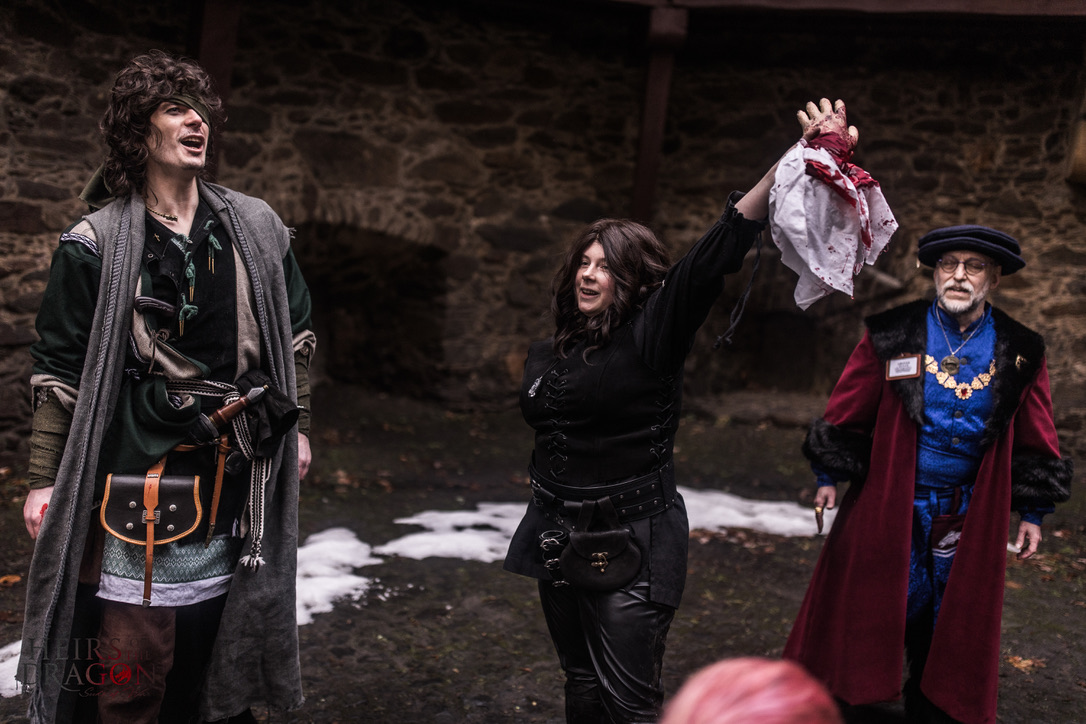
I did get one great scene that played out exactly as I’d planned it. One of the biggest secrets in my character sheet was that I had killed my own father. He’d been losing his capabilities, and failing to manage the budget or maintain the castle, and making bad decisions (including banishing my commoner girlfriend and making me marry instead some minor noblewoman I’d never met, though that part turned out okay in the end), and it was clear that as long as he remained in charge things would continue to get worse. So I’d poisoned him, making sure to cover my tracks, but I was increasingly haunted by that decision… and, in particular, feared that the Gods, particularly the Stranger, were preparing some form of retribution for my crime. I did, I think, a great job of performing guilt and secrecy and dropping dark hints, but the point of a secret in LARP is that it must eventually come out, and I was just waiting for the right opportunity.
The opportunity arose during the Faith of the Seven prayer service on the second night of the game. Lady Tully was a very faithful follower of the Seven and I was also an adherent, though not so stalwart, so we were among the minority who attended the service (as opposed to the orgy, which was held at the same time). The ceremony was held in the sept, which I believe had been a wine cellar of the actual castle and was suitably atmospheric and echoey. We all lit candles and recited the Litany of the Seven Paths, and then the Grand Septon, an NPC and a fine actor, gave a compelling but brief sermon, ending with a request that if anyone felt the need to speak they should do so now.
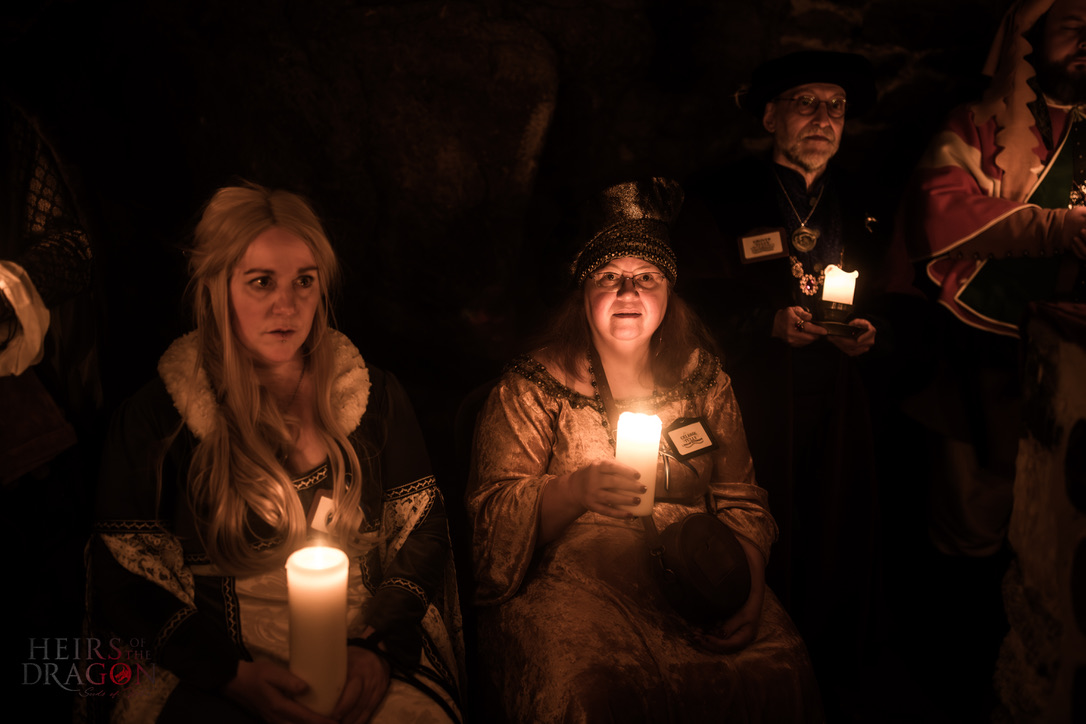
And I did. I totally broke down crying and confessed that I was a kinslayer, that I had murdered my own father, but that I had done it for the sake of the family. “Family! Duty! Honor!” I wept, pounding my chest with each word. It was the Tully house words and I had done my best all game to keep them in mind. “Family! Duty! Honor! … Family! Duty! Honor!” The Faith of the Seven doesn’t do confessions, I think, but that was sure good for my soul and I felt a lot lighter after that. (Walter later asked if I needed to fear the King’s Justice, as a confessed kinslayer, but honestly I never considered that and, indeed, there were no consequences to my confession except that a number of players said they thought it was a great scene.)
One of my biggest worries, according to my character sheet, was my son Walter. Even though I’d set him up with a nice knighthood and sent him off to the Citadel to study to be a Maester he didn’t seem particularly interested in either war or academia, or girls. But I’d heard rumors from the Citadel that he’d been researching poisons and exchanging letters with unknown parties, and I was worried sick that Walter was going to poison me as the Gods’ punishment for my own patricide. So my character sheet said that I was getting increasingly paranoid about him, and also couldn’t trust his mother, who I assumed would take Walter’s side in any conflict with me. This problem was at the very top of my mind for literally months before the game. But when we arrived in Poland and actually met Walter’s player, my worries evaporated and I couldn’t be paranoid the way I was supposed to. He was such a lovely person and I never, ever got the vibe off of him that he was planning anything nefarious. So I dropped that aspect of my character and played my relationship with Walter as that of a concerned father who was worried that his son didn’t seem particularly ambitious. Later in the game I did ask him about the horrible rumors I’d heard that he’d been researching poisons, but he explained that he was doing it for a friend and I thought nothing more about it. And then he stood up and declared that he was going to try to be the patron of the River Road, and even though that plan foundered on the resistance of a few powerful Lords I didn’t think less of him for it.
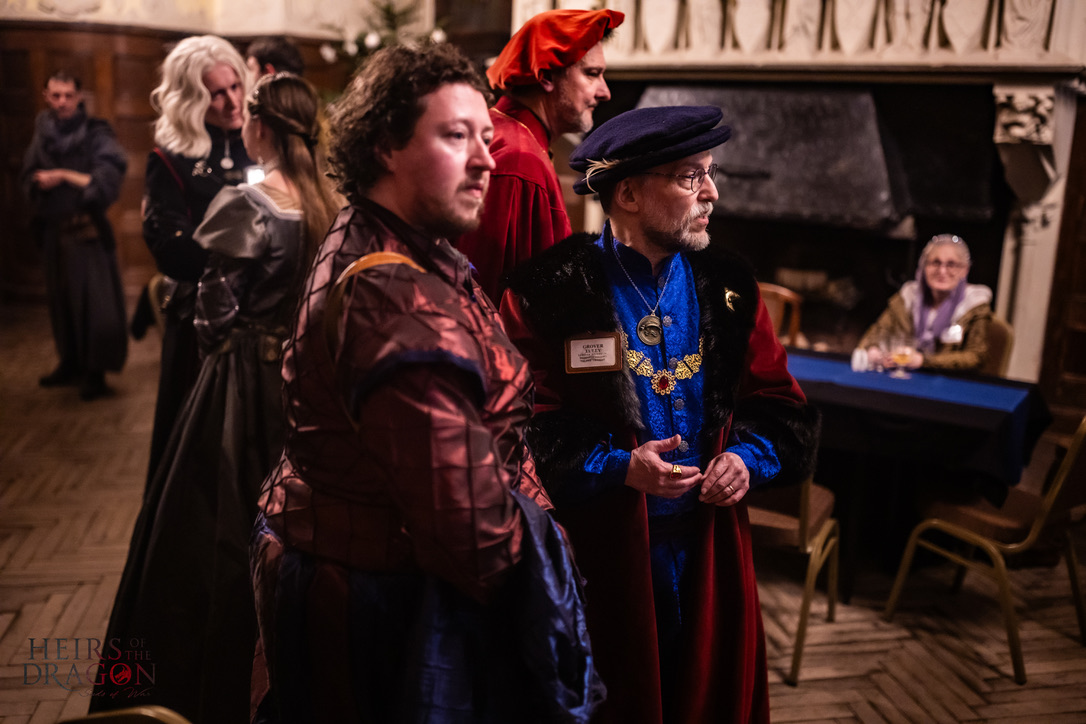
I was also proud of Walter when, after approaching several young ladies (and keeping me informed as to his progress) he went ahead and proposed to Lady Johanna Westerling, and she accepted! I was genuinely pleased and proud. (Also glad that I have learned to pack an engagement ring for all LARPs.) Okay, there was that nasty rumor that she was pregnant with a Lannister bastard but I was prepared to overlook that, and Walter said he’d postpone consummating the marriage to make sure that there would be no questions about the firstborn’s parentage, so all was good, right?
There was a lot to do to make the wedding happen. We needed to negotiate the dowry, of course, and sign the betrothal contract, and make decisions about inheritance (the Westerlings were a pretty significant house themselves, and we eventually decided that the first-born son would inherit the Tully name and estate and the second-born the Westerling name and estate), and find a venue for the wedding, and find the necessary cloaks for the Westerosi wedding ceremony, and oh yes an officiant! We were beyond happy that the High Septon himself (basically the Pope!) agreed to officiate, and we set the ceremony for 10am the next day. But at 9am the next day there was an unexpected funeral (well, not that unexpected, this is a George R. R. Martin game after all) and as it was a member of the Royal Family who had died the High Septon officiated at that as well. But as long as it didn’t run long we’d be fine. And then, halfway through the ceremony, the High Septon started coughing up blood, and died right there in front of everyone.
Okay, I will admit that some of us had known that he wasn’t in the best of health, but it was still a shock and the timing couldn’t have been worse. Not only had we lost our officiant, but in the wake of the Pope’s death every other clergy person of the Faith of the Seven was running around with their hair on fire and none of them were available to stand in for him. So we had to postpone until… well, we didn’t know when. (It was right around then that I failed to meet with Princess Rhaenys.)
Then, as we were coming back inside after having our portrait photos taken (it was an out-of-game event but I made sure that Johanna and her lady-in-waiting Eleanor were included in the Tully family portrait), Johanna asked “are we back in game now?” and as soon as I said yes she clutched her stomach and fell over in pain. Blood everywhere, she said. (We were not allowed to use fake blood in the castle, so that was one thing where you had to take a character’s word for it… everything else in the game was “what you see is what you get.”)
I summoned a Maester and he looked her over and said that she would be fine. But… I knew from my reading that the drug Moon Tea could be used to induce miscarriage, with exactly those symptoms. Still, though, I thought we would all be better off with a miscarriage than a baby of questionable parentage, and so all I did with this information was to reassure her that we loved her and would welcome her to the family despite any peccadilloes in her past… as long as she promised to behave going forward, hm? Despite that teensy little incident, we did manage to make the wedding come together and they finally got married in the morning of the last day of the game. And everything went well for the happy couple after that, except that Eleanor decided to run off to Essos. Oh well, it’s so hard to find good help nowadays.
It was only after the game was over that we learned that Johanna had actually been pregnant with someone else’s child, but had claimed that it was Jason Lannister’s and blackmailed him about it, at the same time she made a contract to marry Walter. Walter and Eleanor convinced her to drink Moon Tea without any of them knowing that the actual father of the child had already sneaked some into her regular tea. This turned out to be quite bad for Johanna’s health and would probably mean that she couldn’t have children. Also she was beating Eleanor black and blue all the time, which explained why Eleanor ran off, and furthermore Johanna was planning to kill me and Lady Tully as soon as we got back to Riverrun. All of this was completely unknown to me, though Lady Tully had her suspicions and was making her own plans to push Johanna down the stairs at the first opportunity. Fun times.
That wasn’t the only time I was far too trusting. At one point, late in the game, one of the Starks came to me and said “The Wildings are absolutely pouring over the Wall… ten thousand already, with forty thousand more behind them. And if they get through the North, the Riverlands will be next. You must send every man you have to the defense of the realm.” And so I did, sending a raven to Riverrun instructing them to send all our troops to the Wall (I had a pretty respectable army) and asking all of my bannermen to do the same. All of them complied — including the Freys and the Rootes, who only agreed to do so if they got to see each other’s letters immediately before handing them over to the ravens — but most houses did hold a few hundred troops back for defensive purposes. I should have done so as well, because later I realized that I’d just left Riverrun completely defenseless on the word of one random Northman. Mind you, he was telling the truth (though the number of Wildings had grown quite a bit in the telling), and in the end nothing bad happened because of my gullibility.
Oh, and I also found out after the game that Walter had told me a teensy fib about why he was researching poison. He had actually given the poison to his boyfriend (!?) which he used to kill his wife. (!?!?!) But he wasn’t planning to kill me after all, so that’s all right I guess. (The boyfriend wound up getting sent to the Wall, which is kind of the Westerosi equivalent of the YMCA.)
So. Bottom line, it was one of the best LARPs I’ve played and I would totally play it again. As I said, there were so many different games being played at the same time, and I would love to have participated in some of the others. I never visited the tavern or the whorehouse, or the Godswood, or any of the secret passages (yes, there were secret passages), and I only saw the dragon (yes, there was a dragon) out-of-game. I think if I had the choice I’d be a Maester next time… there were some wicked intrigue, mysticism, and assassination plots going on there, and I’d get to go into the raven loft (which I’m told had a spectacular view). But in the end… I played the game, I even attended a wedding, and I did not die, so I guess I won.
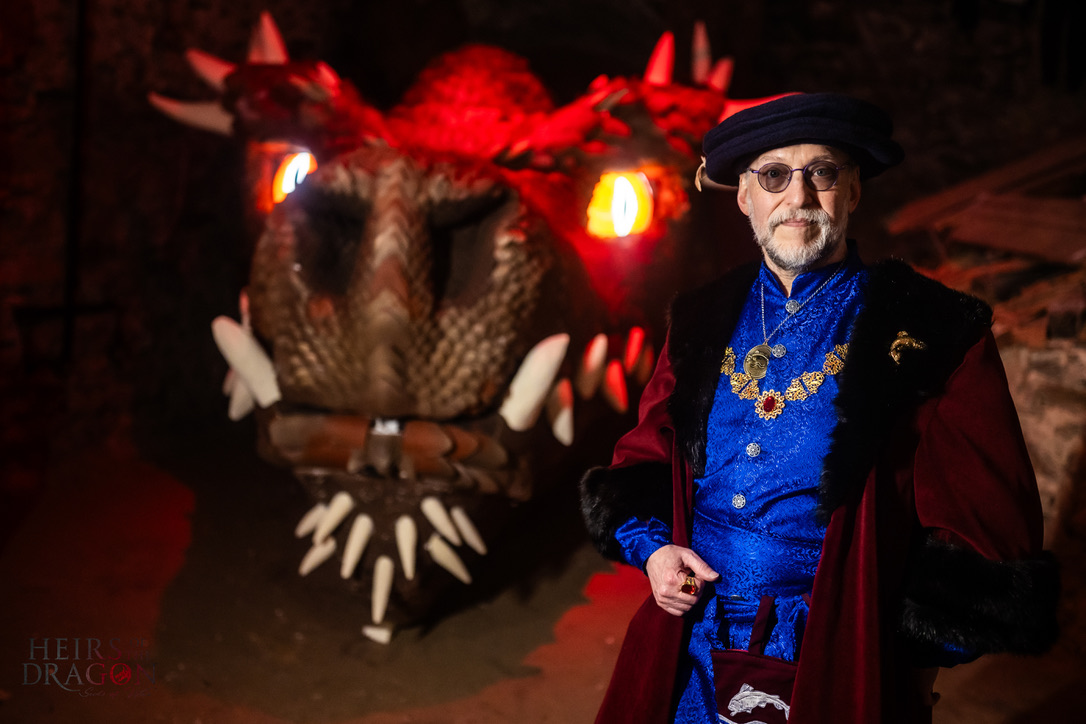
Credit to Charmed Plume and Wonderlarp for the LARP and Rekografia for the photos.
Tags: larp
Dear David,
thank you for this marvelosu write-up!
I am especially happy that you enjoyed our service of the Seven, a scene that you enriched a lot by your input and acting.
Blessed be ;-)
Oliver (The High Septon)
I played Viserys in the first run. Best LARP I’ve ever played. Glad to hear they caught lightning in a bottle twice.